Discrete and Algorithmic Mathematics Red de Matemática Discreta y Algorítmica
Recent Trends XIV: Colourful questions and seating plans
01 Jul 2026What a wonderful thing it is to be able to learn from other people. It is especially enriching when we step outside our usual circles, because then we get to hear about things that are very different from our day-to-day lives. These interactions are often transformative, not only in how we understand the world beyond our bubble, but also in how they can change the way we do the things we are used to doing.
In science and mathematics, this is no different. One of the most exciting things a mathematician can do is to find a connection between seemingly unrelated concepts, areas, or ideas. These bridges are exciting because they change the way we reason about things on either side.
Combinatorics, and especially graph theory, is a very good case in point. We shall see how it allows us to connect guessing games, network search, seating arrangements, colouring problems, and Sudoku-like puzzles.
Guessing, searching, colouring and decompositions
It goes without saying that searching is a fundamental operation in today’s world. We look up the meanings of words in a dictionary, search for nearby restaurants, filter emails, and try to locate defective or malicious nodes in communication networks.
Google has said that people make more than 5 trillion searches on Google each year, and OpenAI told Axios, as reported by TechCrunch, that ChatGPT receives billions of prompts per day. Taken together, these searches and prompts require a very large computing infrastructure, with associated energy and cooling costs. This is one reason why developing efficient query strategies is a core problem in computer science.
Searching for information is deeply connected to guessing games. In fact, the two are, in many ways, two sides of the same coin. This is our first bridge: we may think of queries as a way to narrow down a pool of candidate places where the desired information or item might be stored.
Here is a concrete problem. Suppose one is given a graph with $n$ vertices and $m$ edges, one of whose edges is defective; think of a failure in a network or circuit connection. In other words, our guessing game is to find the defective edge quickly. Our goal is to identify it using as few queries as possible.
Formulated in this way, the question is still a bit too vague. Let us say that a query is a subset of edges, and that each query $Q$ can result in one of two answers:
- YES: the defective edge lies in $Q$;
- NO: the defective edge does not lie in $Q$.
It is not difficult to devise a divide-and-conquer strategy in this scenario:
- label the edges with distinct binary strings of length $\lceil\log_2 m\rceil$;
- for each bit position $i$, make query $Q_i$ be the set of edges whose label has a 1 in the $i$-th position;
This works because any pair of distinct edges $e$ and $f$ must have labels that differ in some bit, say the $j$h bit. Then $Q_i$ contains either $e$ or $f$, but not both, so the answer to the query $Q_j$ distinguishes these two possibilities. Equivalently, the full vector of yes/no answers uniquely identifies the defective edge. Thus $\lceil \log_2 m\rceil$ unrestricted yes/no queries suffice.
Path queries
So far, so good. But what if some questions are more natural, practical, or cheaper than others? A question proposed by Gyula O. H. Katona, and which also appears in the network-design and electrical-engineering literature, asks for the worst-case number of queries needed in an $n$-vertex graph if each query must be a path.
In this case, the number of edges might be quadratic in $n$, and we already know that, if no restriction were placed on the queries, then a logarithmic number of unrestricted queries would suffice.
Here is a strategy:
- Find a small collection of edge-disjoint paths $P_1,P_2,\dots,P_s$ whose union is the whole edge set. Think of the edges in $P_i$ as being coloured with colour $i$.
- Find another collection of paths $R_1,R_2,\dots,R_t$ such that every edge lies in some $R_i$, but no $R_i$ repeats a colour among its edges.
We call the paths in the second category rainbow. If we have these two collections, then we can find any defective edge with $s+t$ path queries.
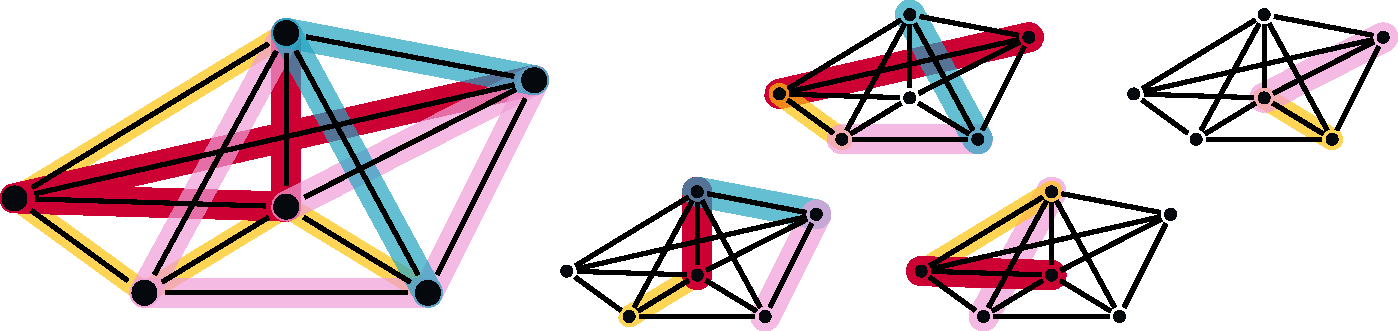
Indeed, ask, for each of the paths $P_1,\dots,P_s,R_1,\dots,R_t$, whether it contains the defective edge. These answers identify the defective edge because the combined family of paths separates every pair of edges.
To see this, take two distinct edges $e$ and $f$. If $e$ and $f$ have the same colour, choose a rainbow path $R_j$ that contains $e$. Since $R_j$ is rainbow, it cannot also contain $f$. Thus $R_j$ distinguishes $e$ from $f$. If $e$ and $f$ have distinct colours, then the unique path $P_a$ containing $e$ in the first decomposition does not contain $f$. Thus $P_a$ distinguishes $e$ from $f$.
So every two edges give different answer patterns. The edge whose pattern matches the answers to all $s+t$ queries is therefore the defective edge. This means that, if we can build these two collections of paths, then $s+t$ is an upper bound on the number of queries needed in the worst case.
This extends our collection of bridges: searching for an edge in a network is related to edge decompositions of (edge-coloured) graphs.
Edge decompositions and seating arrangements
Our next connection dates back to a famous problem proposed by the mathematician Gerhard Ringel during a conference at the Oberwolfach research centre:
A group of mathematicians meets for a few days at a workshop in Oberwolfach. Every day, they all dine together. Can we come up with seating arrangements such that each person has different neighbours every day, and such that, after a few days, every pair of participants has sat side by side exactly once?
Here is the graph-theoretic translation: a seating arrangement around circular tables gives a collection of cycles, one cycle for each table. The pairs of people who sit next to each other are the edges of those cycles. Solving the problem means decomposing all edges of the complete graph on the participants into copies of the same cycle pattern.
Here is a small example. Suppose our conference participants are Alex, Bruna, Carla, Diana, and Eric, and suppose they will always sit at the same table.
It turns out that we are in luck. On the first day, they sit in cyclic order. This uses 5 pairs of people who sit side by side. The unused pairs form precisely another cycle of length 5, which gives our arrangement for the second day. After these two days, everyone has sat next to everyone else exactly once.
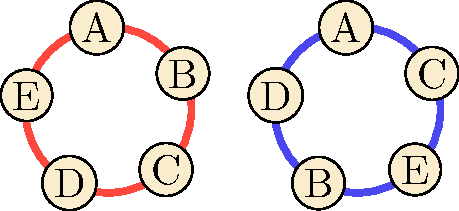
Coincidence? Not quite. It turns out that, for every sufficiently large odd number of participants, and for any prescribed way of splitting them into circular tables of size at least 3, such a seating plan exists. This was shown by Stefan Glock, Felix Joos, Jaehoon Kim, Daniela Kühn, and Deryk Osthus in their 2021 resolution of the Oberwolfach problem.
No solution is possible, in this exact form, for an even number of participants. This is because at every meal each person sits next to exactly two others. Therefore, the number of people we “check off” from anyone’s list of meal-neighbours is always even.
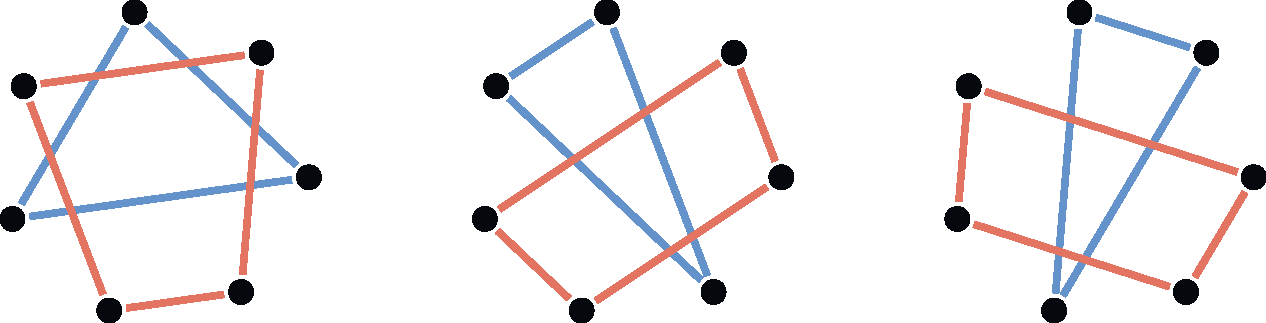
Here is a solution for 7 people, using two ordinary round tables, one of size 3 and one of size 4. This requires 3 days.
Sudokus and coloured networks
Sudoku is a well-known puzzle game in which a $9\times 9$ grid is to be filled so that each row, each column, and each of the nine $3\times 3$ subgrids contains all the numbers $1,2,3,\dots,9$.
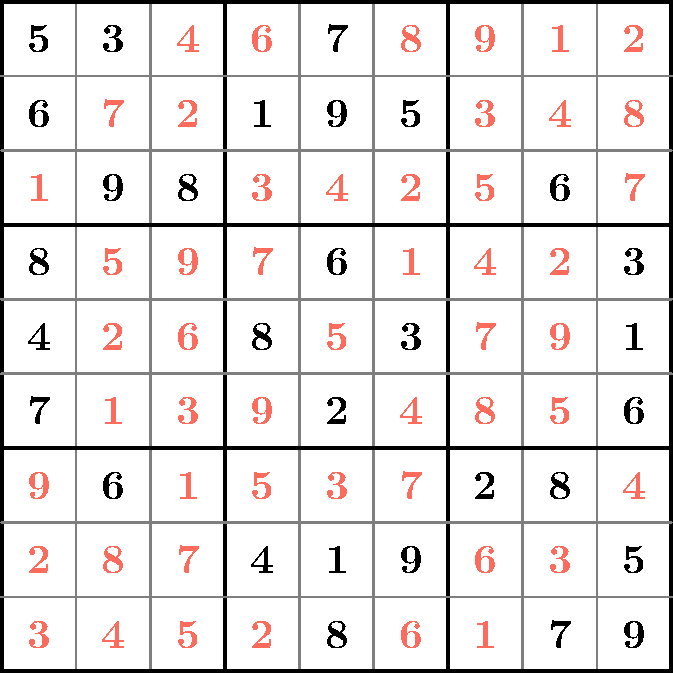
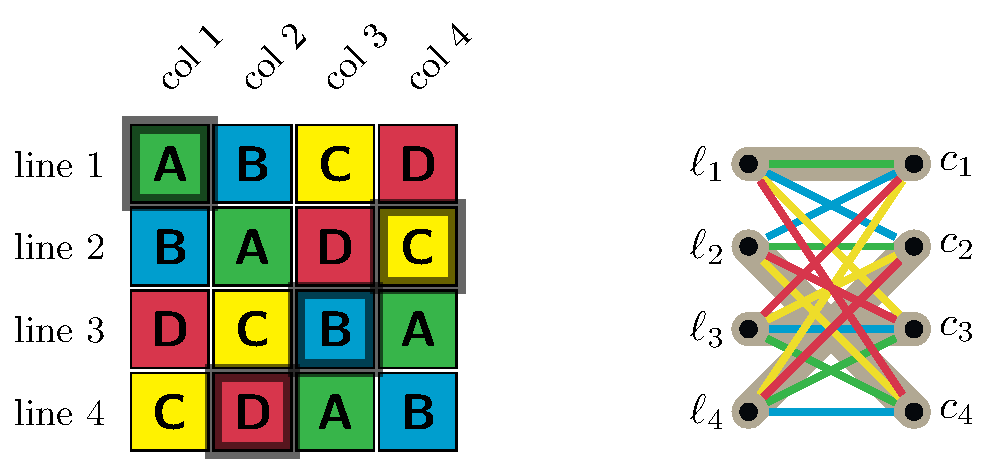
A completed Sudoku grid is a type of Latin square, with the extra condition imposed by the $3\times 3$ subgrids. Latin squares have been studied for centuries by many mathematicians, including the illustrious and prolific Leonhard Euler. A Latin square is simply an $n\times n$ table whose cells are filled with $n$ symbols, with no symbol repeated in any row or column.
One particular theme in the study of Latin squares is the search for a transversal. This is a set of $n$ cells containing one cell from each row, one cell from each column, and one occurrence of each symbol.
And here is another bridge, or two: a Latin square turns out to be equivalent to a specific type of coloured graph. We take two collections of vertices, one representing the rows and the other representing the columns. Then, for each cell, we join the corresponding row-vertex to the corresponding column-vertex, and colour the edge with the symbol appearing in that cell.
In particular, a transversal is a perfect matching whose edges have pairwise distinct colours: a rainbow perfect matching in the graph.
More connections
This completes our foray into mathematical connections. Lurking behind these there is another network of connections (pun intended): the one between researchers with whom I have had the honour of discussing these topics, and many other interesting things.
A big shout-out to the following collaborators! 👋
- Marthe Bonamy (Centre National de la Recherche Scientifique)
- Fábio Botler (Universidade de São Paulo)
- François Dross (Université de Bordeaux)
- Antônio Kaique (Universitat Politècnica de Catalunya)
- Guilherme Oliveira Mota (Universidade de São Paulo)
- Jozef Skokan (London School of Economics)
- Walner Mendonça (Universidade Federal do Ceará)
- Lyuben Lichev (Technische Universität Wien)
- Jaehoon Kim (김재훈) (KAIST)
- Marc Noy (Universitat Politècnica de Catalunya)
Pint of Science: my experience and thoughts
This was my first time speaking publicly about my research directly to people who were not researchers. As one can imagine, this was both exciting and nerve-wracking. Mathematics has a bad reputation, but this has begun to change as more and more science communicators reach larger audiences on social media.
All that being said, I enjoyed the whole process: interacting with the event organisers, preparing the talk, attending the event as a spectator, and then speaking.
The talks are short, and there is time for a few questions afterwards, with interactive activities between some of the talks: quizzes, and even bingo.
The questions I was asked were interesting. Unsurprisingly, I got asked something along the lines of “So what?” While I had not especially anticipated this question — in hindsight, it is not unexpected after a maths talk — it was actually great. After years of chatting with friends and family members about the purpose of mathematics, I was happy to have an open mic to talk about some of the many faces of mathematics and its value.
- Mathematics has a knack for helping us find flaws in our reasoning, much like touching an optical illusion to see that something is not really moving. Following algorithms, or even mathematics, blindly can be a very bad idea.
- Solving hard problems is a great way to come up with new ideas to attack even harder problems, which is toolbox-building. Solving many problems is also a great way of spotting general patterns, which is theory-building. These are two cultures of mathematics, each of which has its own allure for mathematicians and makes its own contribution.
- And, of course, some mathematics does solve real-life problems surprisingly effectively.
Not to mention the interest in pursuing knowledge for its own sake, which, let us be frank, is no shabby reason!
With all this being said, I look forward to participating in other editions of the Pint of Science and related events, and got me curious to try to collaborate with other science divulgation initiatives.
Tássio Naia is an MSCA research fellow at the Centre de Recerca Matemática, working with Guillem Perarnau and the GAPCOMB-UPC group.